
From modern consoles like the PlayStation 5, Xbox Series X/S, and Nintendo Switch, to various PC gamepads, almost every controller features a “cross-shaped directional input device.”
Now globally beloved as the “D-Pad” (Directional Pad), this interface was not the industry standard from the very beginning. Behind its creation lies the “physical constraints” unique to handheld gaming devices and the extraordinary “inspiration” of Nintendo’s legendary creator, Gunpei Yokoi.
Why was the D-Pad created, how did it become an invincible patent that kept competitors at bay, and how has it survived to this day? Let’s unravel its profound history.
The Joystick and the Limits of “Buttons”
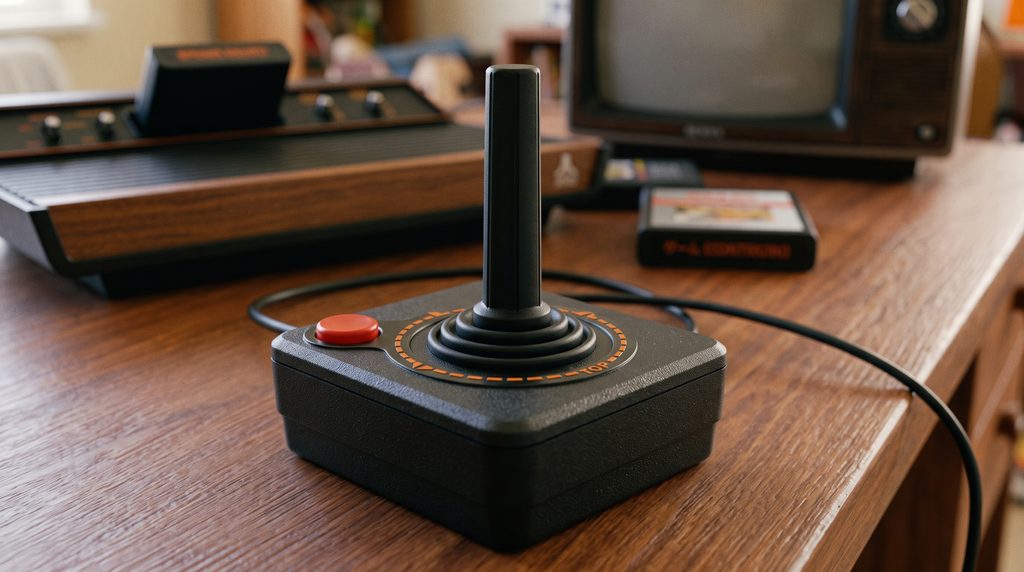
From the 1970s through the early 1980s, the absolute king of directional input in gaming was the “joystick” (lever) of arcade cabinets. Early home consoles like the Atari 2600 also adopted stick-style controllers in an attempt to bring the arcade feel directly into the living room.
Meanwhile, in the early titles of the handheld LCD “Game & Watch” series released by Nintendo in 1980, lateral movement was handled by “two independent round buttons.” Since many games at the time only required simple horizontal movement, this functioned perfectly well.
However, in 1982, Nintendo faced the massive challenge of porting the arcade smash hit Donkey Kong to the Game & Watch. The protagonist, “Rescue Man” (later known as Mario), needed the freedom to move in four directions—climbing ladders up and down, and running left and right.
If they wanted players to control it just like the arcade version, attaching a small joystick to the device would be the most natural choice. However, the Donkey Kong Game & Watch utilized a “clamshell” (multi-screen) design with dual top and bottom screens. If they added a protruding lever to the control panel, the device simply wouldn’t be able to fold shut.
“We need a flat device that fits in a pocket-sized, slim body, but still allows for intuitive four-way control.” To solve this seemingly contradictory puzzle, the D-Pad was born.
Gunpei Yokoi’s Inspiration and the Magic of the “Fulcrum”
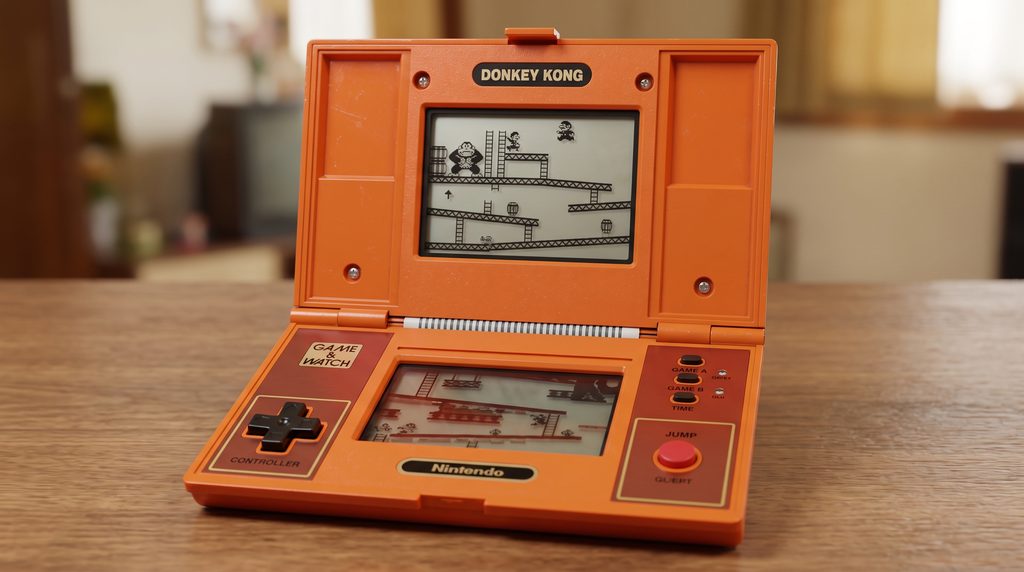
Gunpei Yokoi, who spearheaded the development, devised a structure that was incredibly simple yet highly functional.
It consisted of a plastic “cross-shaped plate” with a slight “round protrusion (fulcrum)” on the center of its back, placed over four switches (conductive rubber) for up, down, left, and right.
This “central fulcrum” was the greatest invention of the D-Pad. When a player placed their thumb in the center of the cross, the plate tilted like a seesaw pivoting on the fulcrum. Press up, and only the top sank; press right, and only the right side sank. Without ever lifting their thumb off the button, players could seamlessly change directions simply by shifting the “weight” of their thumb pad.
There was no frantic pressing of the wrong button among four independent keys, nor was there a need for the physical height of a joystick. Thanks to this ultra-thin D-Pad, the handheld Donkey Kong became an explosive mega-hit.
Integration into the Famicom and the “Invincible Patent”
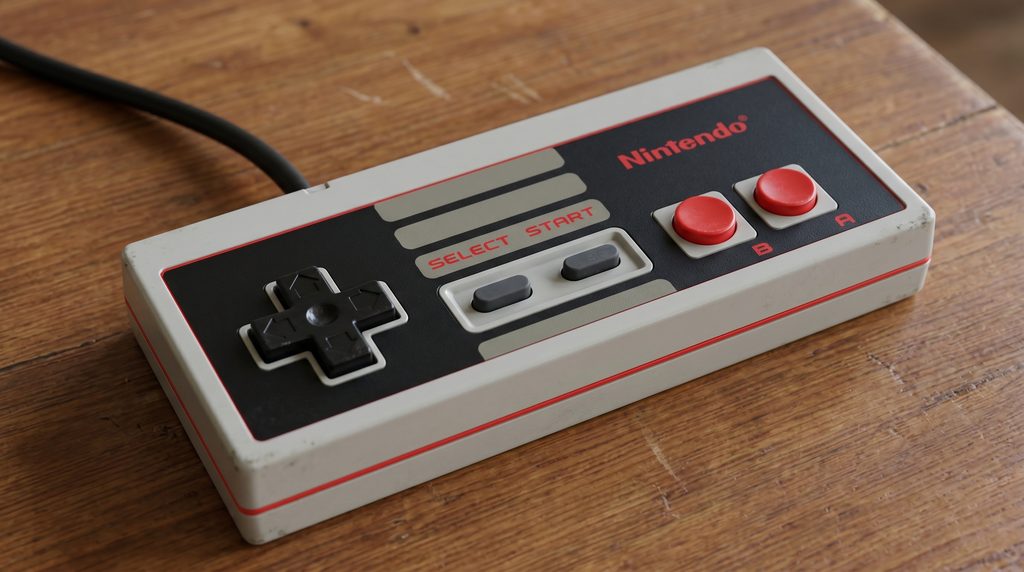
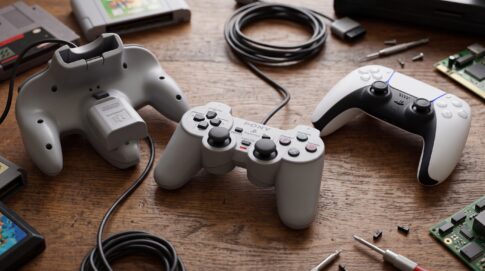
Following its success on the Game & Watch, this D-Pad structure was adopted as standard on the Controller I (left side) of the “Family Computer” (Famicom/NES), released in 1983.
With the D-Pad integrated into a home console, players experienced less finger fatigue even during long sessions and were able to execute precise, millimeter-accurate action controls. The delicate jumps and dash controls of Super Mario Bros. simply cannot be discussed without the D-Pad.
At this point, Nintendo secured a highly robust utility model and patent for this revolutionary input device: “A multi-directional switch composed of a cross-shaped key top and a central fulcrum.”
As the Famicom became a social phenomenon worldwide (as the NES overseas), the D-Pad became the de facto standard for game controls. However, competitors were blocked by the patent wall and could not manufacture controllers with the exact same structure.
The Competitors’ Design War to “Evade the Patent”
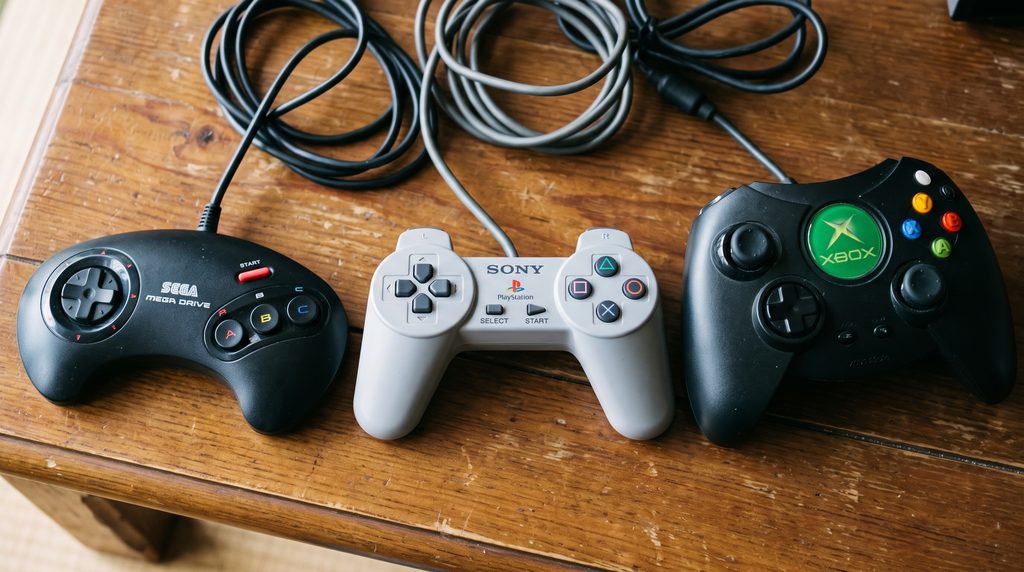
How do you create a comfortable directional pad without infringing on Nintendo’s D-Pad patent? From the late 1980s through the 90s, rival companies went through agonizing ingenuity and unique evolutionary steps.
- Sega: The “Bowl/Disc Shape” That Shined in Fighting Games For the Mega Drive (Genesis) and Sega Saturn, Sega opted not for a simple cross-shaped plate, but a design featuring a cross-shaped protrusion sitting atop a round disc (bowl shape). By avoiding Nintendo’s explicit “cross-shaped plate” structure while designing the disc to tilt smoothly, this directional pad inadvertently created a unique advantage: it made “diagonal inputs” exceptionally easy. The Sega Saturn controller, in particular, is still praised by many fans today as the “greatest ever for 2D fighting game command inputs.”
- Sony: The “Independent Button Illusion” Using Visual Trickery When developing the original PlayStation in 1994, designer Teiyu Goto took a groundbreaking approach. Externally, it looked like four independent directional buttons were placed on the controller. In reality, inside the casing, those four buttons were connected as a single piece of plastic. Because there was no central fulcrum, it completely bypassed Nintendo’s patent, yet it achieved an operational feel close to a D-Pad by allowing players to slide their thumb pad across it. This “four directional buttons” design has been passed down as the identity of the PlayStation brand, all the way to the latest PS5 (DualSense).
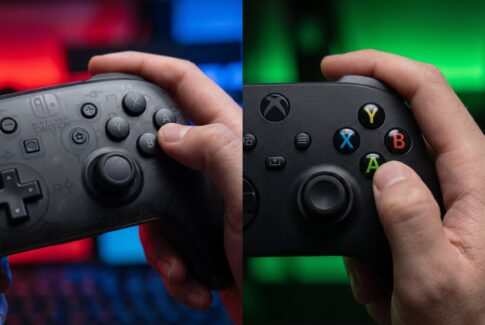
- Microsoft: The Fusion of Disc and Cross For the original Xbox and Xbox 360 controllers, Microsoft adopted an approach closer to Sega’s, placing a cross atop a disc-shaped base with eight directional indentations. While early models faced challenges with input precision, unique refinements were made over the years. Today, it has evolved into the high-quality, faceted D-Pad seen on premium devices like the Xbox Elite Wireless Controller.
The “Product of Compromise” That Became an Eternal Standard
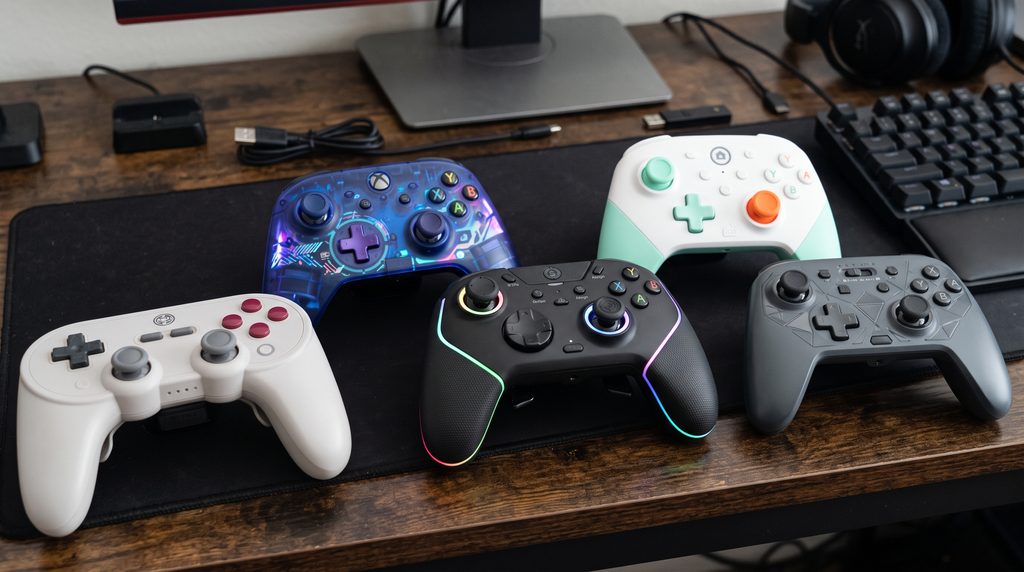
The basic patent held by Nintendo for the D-Pad expired around 2005, 20 years after its filing. Today, not only third-party PC gamepads but also hardware from companies other than Nintendo can freely adopt this perfected, simple “cross-shaped design” without restriction.
In modern 3D gaming, the lead roles for character movement and camera control have shifted to analog sticks. Yet, the D-Pad has never disappeared from our controllers. For instantaneously switching weapons, navigating RPG menus, selecting UI elements, and executing the precise inputs required in 2D action and indie games, no device has yet emerged that can beat the D-Pad for clearly and intuitively registering digital “ON/OFF” inputs.
A flat, cross-shaped plate born as an unavoidable workaround for the physical constraint of “closing” a clamshell console—more than 40 years later, this greatest “product of compromise” still sits firmly beneath the left thumb of gamers, supporting the entire gaming industry.






コメントを残す